
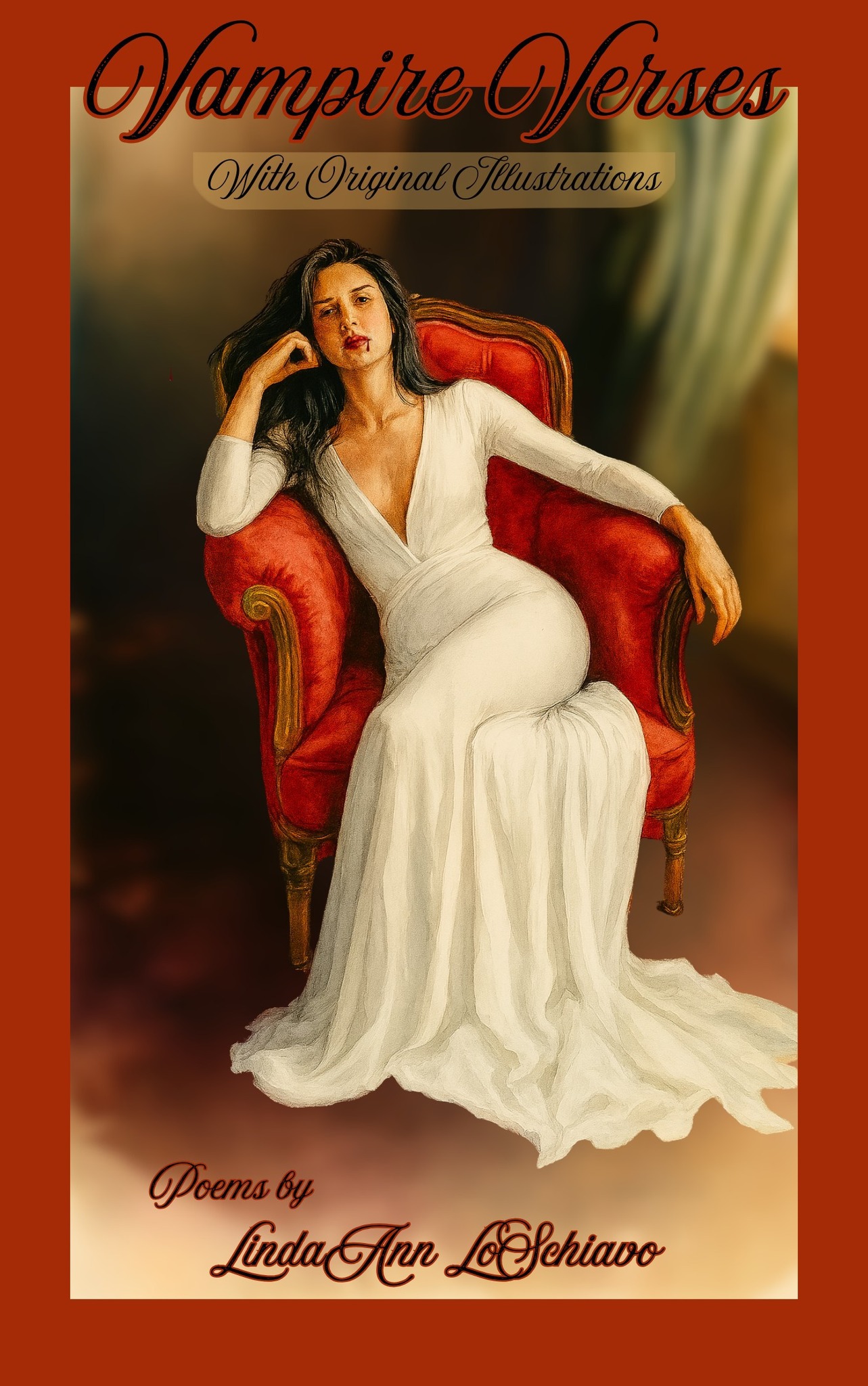
by LindaAnn LoSchiavo

I. The Contradiction
Writers are not vampires. And yet we are the ones responsible for keeping them alive.
J. Sheridan Le Fanu was, by every measure, an unlikely candidate for the imaginative leap he made in 1872.

Conservative. Married. A Protestant Tory in Victorian Dublin. A man whose earlier fiction trafficked in corrupt aristocratic males — judges, earls, demon lovers — the familiar villains of his class and era. Nothing in his biography would suggest the audacity of what he was about to do: crawl inside the consciousness of a teenage lesbian vampire and make her pitiable, relatable, and world famous.
Poets are not vampires either. We do not drink blood. We are alive, breathing, tethered to our own century, our own bodies, our own fears. When COVID blanketed the world in 2020, I was not stalking through Styria, Austria. I was not ancient, blood-thirsty, nor undead.
And yet something in Carmilla’s situation — her hunger, her isolation, her hunt disrupted by a world suddenly made toxic and strange — pulled me into that primal terror. Imaginative obsession doesn’t announce itself politely nor knock and pause for permission. It simply arrives, cloaked in a character’s urgent quest, and enters.
This is what Le Fanu knew. This is what any poet who has ever inhabited a monster knows: the crossing of that threshold is also the creative spark that lights the blaze.
II. Carmilla Unpacked
Two decades before Bram Stoker’s Dracula, Le Fanu introduced readers to something far more unsettling than a distant Transylvanian count — a beautiful, melancholic temptress named Carmilla Karnstein, simultaneously victim and predator, capable of genuine tenderness and genuine destruction.

Instead of being a straightforward villain, Carmilla is a complex creature. She exhibits what modern readers will recognize as borderline personality disorder: demanding affection when rejected, withdrawing when it’s offered. Moreover, she was turned against her will, possibly trafficked by the woman posing as her mother, which makes her sympathetic. She seduces slowly, almost lovingly, and her victim Laura never fully disentangles her complicated feelings — not even after understanding exactly what Carmilla was.
The novella operates on multiple levels at once. On its surface, it’s a Gothic horror story. Beneath that, a coded political allegory: the story is set in Styria, rural Austria, but Le Fanu — himself Anglo-Irish, himself caught between colonial identities — was writing about Ireland. Carmilla represents the seductive danger of English nobility, charming the Anglo-Irish elite while quietly devastating the vulnerable. Laura’s father, an English expatriate, ignores every warning sign about his guest because of the prestige she offers. Le Fanu knew this blindness intimately. He had seen it operate his entire life.
Deeper still, the novella is a queer text that refuses easy readings. Carmilla is predatory, yes — she touches Laura without permission, makes possessive threats, manipulates. But Le Fanu renders her execution at the hands of the cold, clinical Baron Vordenburg with unmistakable distaste. We are not meant to feel relieved. We are meant to feel the loss of something that could not, in Victorian England, have survived any other way.
Carmilla Karnstein is the original morally shaded vampire. Not a distant aristocratic threat, but an intimate one — a predator who engenders sympathy, even as readers recognize the necessity (or the inevitability) of her destruction.
III. The Bridge
What does it mean to write as her rather than about her?
Le Fanu wrote about Carmilla — through Laura’s narration, through the Baron’s clinical report, through the apparatus of Victorian horror fiction with its framing devices and explanatory footnotes. He kept his distance, formally, even as he pressed close imaginatively.
A poet has different tools. A poem can abolish the distance entirely.
When I reread the novella “Carmilla” during the pandemic years, I wasn’t interested in explaining her. I wanted to be inside that moment of return — Carmilla waking into a world transformed, her ancient hunger suddenly complicated by something she had not encountered in centuries. COVID reminded her of the Black Death. The air itself had turned hostile. Styria — her Styria — was deserted and as unrecognizable as my Greenwich Village, eerily stripped of New Yorkers and traffic.
What does a vampire do when the world she hunts in has changed beyond recognition? She adapts. She persists. Hunger doesn’t negotiate with history.
The 25-line blank verse poem that emerged is called “When Carmilla Returns, Styria Is Different.” It might be the most direct line I have ever drawn between my imagination and a fictional character — one invented by a conservative Victorian Irishman, reimagined by me, alive and breathing in a pandemic-altered world neither of us could have predicted together.

IV. The Poem
When Carmilla Returns, Styria Is Different
Covid reminded her of the Black Death,
Fatalities unfolding silently
As muslin shrouds, infecting secretly.
She’s deprived of uninterrupted sleep.
Roused from bleak dreams, Carmilla senses filth
Inside her lungs – uncleanliness. What’s changed?
A pox has blanketed the air with rot,
Its toxic aftertaste. This complicates
Her scheme – thirst urgent as a last request.
Even in darkness, she recalled her curse:
Ceaseless pursuit of youthfulness whose price
Is stolen blood – warm red wealth that buys time.
Without it, she’s the color of waiting.
Disease changed Styria, its ticking stilled:
Tram stops disused, shop signs like tattered skin
Peeling away in grim unhealthy breeze.
Old beech trees loomed like ghostly chaperones.
A curtain flutters like a helpless moth –
Reveals a sleeping, pink-cheeked blonde. Alone.
A vampire knows the contract she has made
With hunger and the power of beauty,
Ruled by unfathomable appetites.
She hypnotizes, casting sly shadows
Shaped like her victim’s most unrealized
Desires, then enters – cloaked in this disguise.
― Ƹ̵̡Ӝ̵̨̄Ʒ―
V. Coda
Carmilla endures — across centuries, across pandemics, across the imaginations of writers who were never her and could never be. That is Gothic horror’s oldest truth: the monster outlives the era that created it, because the hungers it embodies are not Victorian, not pandemic-specific, not historical. They are permanent.
Carmilla became one poem in “Vampire Verse: Poems” in Section One: The Dead Travel Fast. But she was given colorful company.
The chapbook’s 23 poems move through the full architecture of vampire literature — from Le Fanu’s Carmilla to Stoker’s characters in “Dracula,” each poem an act of imaginative obsession, each one a threshold crossed. To complete a project like this, a poet must inhabit one supernatural consciousness at a time — along with the vampire’s newest human victim.
What compelled Le Fanu to create Carmilla remains, finally, what compels any writer toward any monster: the suspicion that the distance between ourselves and the creature is smaller than we’d like to believe.
Moreover, the pen is equipped with options. Contemporary poetry doesn’t need to kill the vampire; instead, it reframes the monster as the ultimate, tragic survivor — a mirror, in the end, of our own desperate desire to never truly die.
NOTES —
Publisher: Twisted Dreams Press
Distributor: Amazon
Date of Publication: November 28, 2025
ISBN-13: 979-8274541350 — — ASIN: B0G31X1Y48
✎ AMAZON
. . . . . . . . . . . . . . . . . . . . . . . . . . . . . . . . .
. . . . . . . . . . . . . . . . . . . . . . . . . . . . . . . . .
IMAGES:
Sheridan Le Fanu (color portrait, 1916)
“Carmilla” — cover
Public domain Carmilla bedroom scene
IMAGES:Book cover for Vampire Verses: Poems— two prize logos posted with it or integrated on the cover
Author portrait with vampire

