

Happy National Poetry Month!
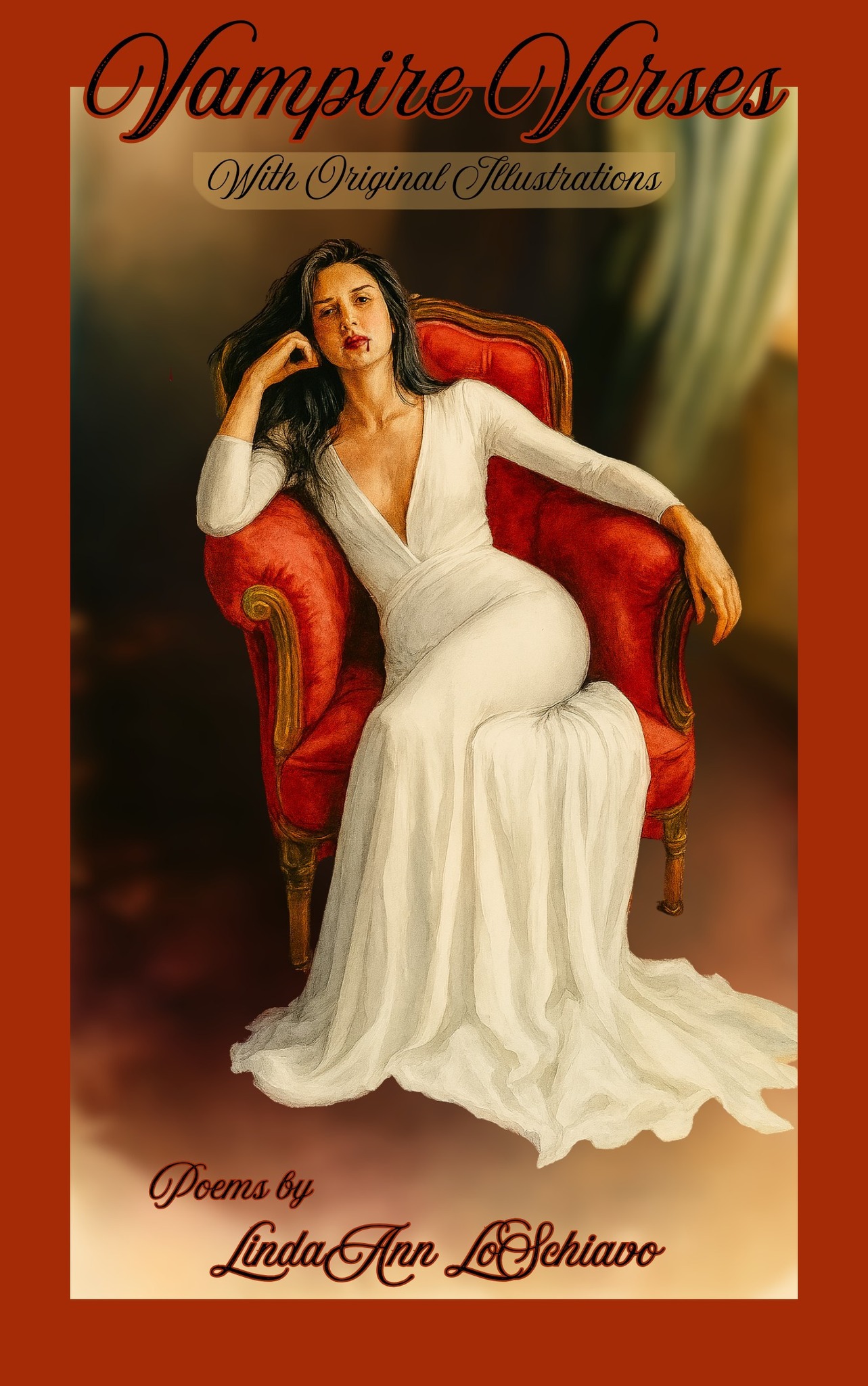
Twisted Dreams Press is thrilled to feature our first and only poet on the blog this month, LindaAnn LoSchiavo. LindaAnn is the author of the horror poetry book, Vampire Verses, which is our very first and only poetry book! (We plan to publish more poetry books in the near future.)
In honor of this month dedicated to poetry, LindaAnn has set aside time to be interviewed for the Twisted Dreams Press blog. Read all about how she came up with the idea for Vampire Verses, as well as what other kind of poetry you can expect to read by her.
1. What is your experience in writing poetry?
My parents were too poor to afford housing so we lived in a large house owned by my grandparents, a busy household that included other family members.
Since I learned to read when I was a toddler, I was given this privilege: whenever greeting cards arrived, I was permitted to read the card aloud at the dinner table as our family gathered for supper.
But the flat-footed “June – moon – spoon” rhymes in Hallmark cards offended me. They were clunky, predictable, and boring. Thus, my Aunt Fay, a talented illustrator, and I started our own modest greeting card line. She drew and I wrote the metrical rhymes. These unique homemade cards were praised and a formalist was born at age 3. [Thanks, Hallmark!]
2. When did you start seeking publication for your poems and what was your first publication?
I went to the library every Wednesday and a reference librarian directed me to literary journals where I could mail in my writing. My first poem was published in a school magazine for NYC pupils.
I was 9 years old and my poem was called “The Tiger.”
The same year, I had my first one-act drama onstage in NYC.
3. What can you tell us about your poetry book, Vampire Verses? What inspired you to write it?
During the pandemic, a fellow started Dracula Daily, which became an overnight sensation. Dracula Daily is an email newsletter that sends you the novel Dracula, in ‘real-time’— as it happens to the characters. It rapidly acquired over 200,000 subscribers and inspired worldwide news coverage.
Though I was not a subscriber, I did become aware of the enormous buzz surrounding Dracula Daily.
Since I had not thought about vampires for a while, a new curiosity rose from the dead.
On my own, I reread Bram Stoker’s classic along with all of the selections gathered in two hefty anthologies edited by Michael Sims and David Skal.
I thought, “What innovations could I bring to this well-worn genre?”
There were a few.
One example: I took a Jane Austen-ish approach to Bram Stoker’s nobleman of means. “It is a truth universally acknowledged, that a single man in possession of a good fortune, must be in want of a wife” became “It is a truth universally acknowledged that a foreign bachelor, in possession of a drafty castle, must be in want of a wife.”
Second example: opportunities that Bram Stoker overlooked, such as Dracula writing a memoir, planning a Hallowe’en soiree, and more.
Third example: adding pop culture and technology to the vampire mythos.
The fourth example was telling a vampire’s rite de passage backward.
Taking a closer look at vampire literature, it seemed there was room for a fresh approach. By free-associating about various things – Wes Craven’s Freddy Krueger films, dating apps, The Playboy Club, Instagram influencers, PhotoShop, humble brags, house hunting, happy hour – I asked myself, “What would a vampire do?” Then I wrote the poems.
4. Have you always been interested in vampires? Are they in any of your other work?
There are a few vampire poems in “A Route Obscure and Lonely,” which won an Elgin Award, and two vampire poems in “Always Haunted: Hallowe’en Poems,” which won 3 awards.
I can’t say I’m more interested in vampires than in other supernatural creatures, but they seem to have brought good fortune to my books.
5. I know there is a lot of focus on Dracula in this book. Is he your favorite vampire?
Dracula is a famous vampire, who has graced stage, screen, and books. However, my vampire serial “Dracula Before Stoker: The Prequel” accords him an original voice, an arch-enemy, and the narrative has shed its dependence on garlic and crucifixes.
6. Do you feel that there are a lot of books of vampire poetry published today?
Maybe –– but many of those lack originality.
7. What other supernatural creatures often appear in your poetry?
Ghosts, witches, supernatural scarecrows, and werewolves.
8. You seem to specialize in writing horror poetry. Why are you drawn to this genre in your poetry?
When I was in the crib, my grandparents introduced me to narratives filled with betrayal, revenge, self-destruction, and Verdi-worthy villains … also known as Italian Grand Opera.
My father created bedtime stories for me every night filled with mobsters, murders, and mayhem on the Brooklyn waterfront. Through these violent tales, he accidentally introduced me to horror writing.
[See “Brooklyn Bedtime Stories” in Heimat Review, Issue 10].
9. What other poetry books can we hope to see from you in the future?
Three are in the pipeline.
I have already completed a sequel to my 2024 suicide collection, Felones de Se, with full-page portraits by Ekaterina Orlovskaya that illustrate each and every poem.
I have a full-length collection, partially illustrated, on my ghost encounters and ghost encounters in my family. A top-tier author blurbed it.
And the third W.I.P. is my werewolf collection, illustrated by Giulia Massarin. “Return of the Werewolf” has a Foreword by a well-known horror editor and some poems have won acclaim.
I’d love to land some of these with a recognized press, such as Raw Dog Screaming Press or Crystal Lake. Fingers crossed.
10. Where can we learn more about you and your writing online?
Substack
YouTube
Amazon

